Reviews
Part of How to think about digital marketing careers
How to prepare for a digital marketing interview
digital marketing interview questions for diagnosing judgment, execution, collaboration, responsible hiring, scorecards, and business-focused follow-ups.
What to take away
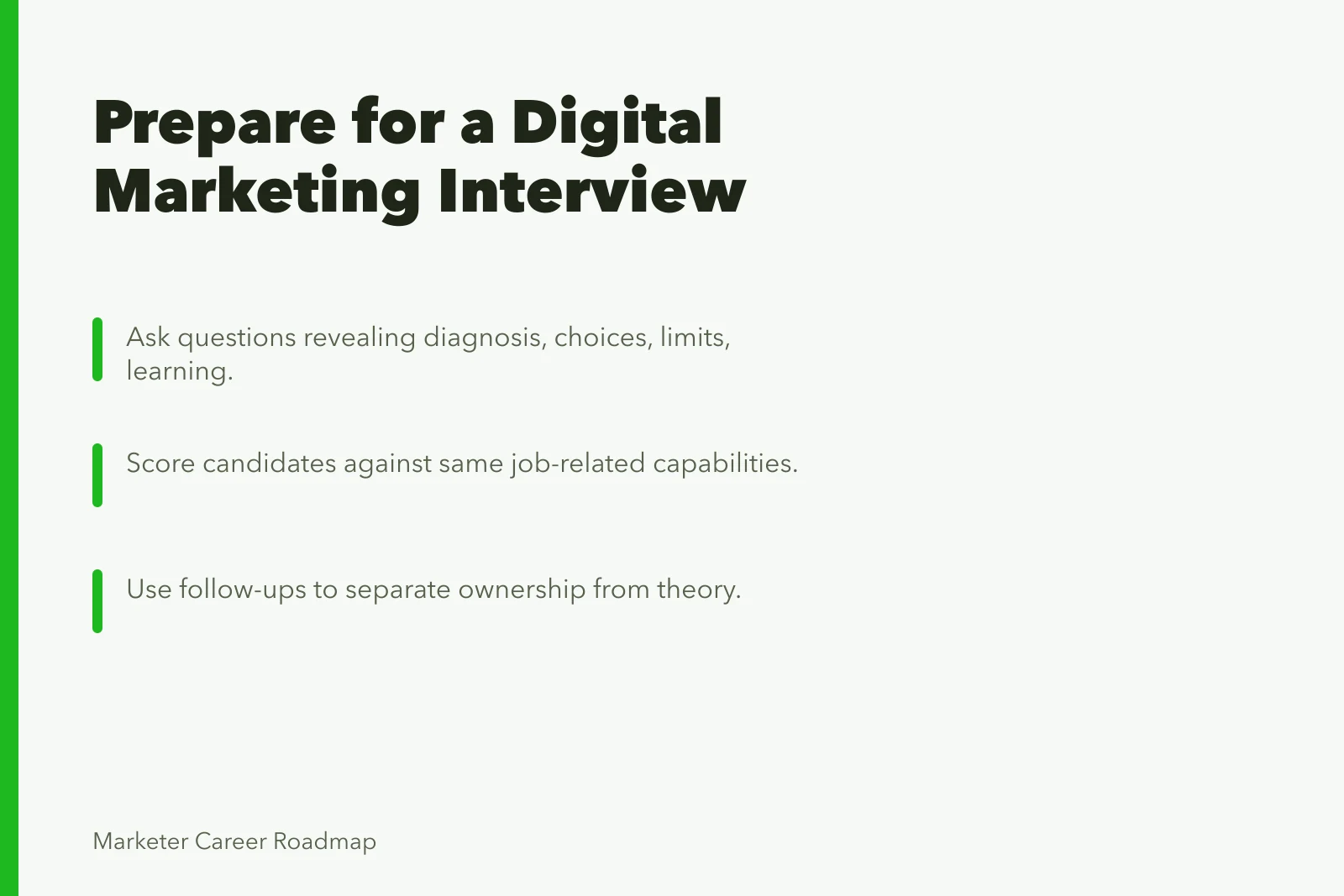
- Ask questions that reveal diagnosis, choices, limits, and learning.
- Score candidates against the same job-related capabilities and evidence levels.
- Use follow-ups to separate direct ownership from observation or rehearsed theory.
Good digital marketing interview questions reveal how a candidate thinks when the brief is incomplete. Definitions and platform features are easy to memorize. Business teams need to learn whether the person can identify the real problem, choose a sensible action, check evidence, communicate limits, and improve after a result.
Make the interview structured and lawful
UC Berkeley's interview preparation guide tells candidates to research the organization and the job description, then practice short answers built from real examples. Prepare two or three stories that carry a situation, your action, and the result.
Structured and lawful interview prep
- Research the organization
- Review the job description
- Prepare examples
- Practice responses
- Tie every question to the work
- Apply the same standard consistently
For employers, the EEOC's overview of prohibited employment practices bars hiring decisions and pre-employment questions that discriminate on protected grounds. Before each loop, list every question beside the job task it tests, and drop any question that maps to none.
Questions about diagnosis
- A campaign is generating more leads but sales rejects most of them. What do you investigate first?
- Organic traffic fell last month. How would you separate a tracking problem from a demand or ranking problem?
- A stakeholder asks for daily posts on every social platform. How would you clarify the objective and scope?
- Which information would you request before recommending a channel?
- Tell us about a metric that looked positive but did not support the business goal.
Listen for a structured investigation rather than an instant tactic. Strong candidates define the outcome, check data quality, segment the problem, and seek customer or operational context before prescribing a fix.
Questions about execution
- Walk us through a piece of work from brief to quality assurance.
- How do you decide what to test when time or budget is limited?
- Describe a mistake you caught late. What changed in your process?
- How do you use AI assistance while protecting accuracy and confidential information?
- Show us a portfolio project and separate your contribution from the team's work.
Probe for details. Ask what constraints existed, which alternatives were rejected, and how the person knew the work was ready. A polished answer without a concrete decision may indicate observation rather than ownership. A portfolio project shown in the interview should match the ownership claims in your digital marketing resume tips.
Questions about collaboration
- How would you explain a weak campaign result to a nonmarketing leader?
- Tell us about feedback you initially disagreed with.
- What do you need from sales, product, or customer service to do this job well?
- How do you handle two stakeholders who assign conflicting priorities?
Model answers to practice with
Use these as shape, not script. Each one names a check, a decision, and a limit.
Leads that sales rejects. "I would start with the form, the tracking, and the scoring rules, because a mismatch there is cheap to fix. If the data is clean, I would ask three sales reps what they hear on calls, then compare close rates by source."
A drop in organic traffic. "I would confirm the analytics tag still fires and compare year over year. Then I would check indexing, lost rankings, and seasonality. I would tell the team what I know, what I do not know, and when I will have an answer."
Two stakeholders, conflicting priorities. "I would ask both to agree on one outcome for the quarter and write down what each one gives up. If they cannot, I would take the decision to whoever owns the number."
Rehearse each one out loud and keep a real result from your own work ready as proof.
Use a consistent scorecard
Set capabilities and evidence levels before interviews. Score every candidate on the same job-related criteria, and record examples for each score. Avoid vague culture judgments that reward familiarity over capability.
For final candidates, a short, paid work sample helps when it reflects the real role, protects company information, and is not used as free commercial labor. A consistent scorecard also helps compare candidates against digital marketing job requirements across different role scopes.
Leave time for the candidate's questions. Their interest in ownership, measurement, customers, and team support can reveal as much as a rehearsed response. Record the answers consistently so the final discussion compares job evidence instead of interview style.
Map capabilities to evidence
| Capability | Question focus | Evidence to record |
|---|---|---|
| Diagnosis | How the candidate frames an unclear problem | Checks, hypotheses, and missing information |
| Execution | How work moved from brief to review | Personal decisions, controls, and corrections |
| Collaboration | How conflict or weak results were handled | Clear communication and shared ownership |
| Learning | What changed after feedback or failure | Specific revision to judgment or process |
Check how a marketing team chooses its tools
Some interviewers ask how you would pick a marketing platform or weigh a vendor claim. The GOV.UK technology selection guidance lists adaptable choices, data control, security review, and ownership cost for UK public services. Treat it as a comparison point, not a rule for a US or Canadian team.
Applicants should also compare how digital marketing roles and responsibilities split channel, customer, and systems work before accepting any offer.
The GOV.UK open standards guidance links open standards with interoperability and reduced supplier dependence. In a North American interview, the matching question is whether the team can move its data and definitions to another vendor without rebuilding everything.
Common questions
How many interview questions should a team ask?
A typical 45 minute loop fits six to eight questions, and a 60 minute loop fits eight to ten, once you allow for introductions, follow-ups, and the candidate's own questions. Test each central capability at least once, and keep room to probe.
What makes a strong candidate answer?
It defines the problem, explains the person's own choices, names the evidence, states limits, and describes what happened next.