Careers
Running email journeys from Austin, Chicago or New York
Email journeys hiring in Austin, Chicago and New York City: agency hubs, lifecycle marketing salaries, hiring costs and remote pay trends for 2026.
What to take away
- Email journeys hiring in Austin, Chicago and New York City differs sharply by salary, agency supply and startup density.
- Austin offers the lowest lifecycle marketing salaries, typically $80,000 to $100,000 for a manager, with agencies clustered around downtown and East Austin.
- Chicago agencies often bundle lifecycle work with deliverability and segmentation retainers for B2B brands, commonly $4,000 to $10,000 a month.
- New York City commands the highest salaries and agency fees, with manager pay near $110,000 to $140,000 and enterprise retainers from $10,000 a month.
- Remote roles compress pay gaps but still anchor to local market rates for email journeys work.
- Budget for agency retainers, tool subscriptions and compliance work.
Austin: agency hubs and lifecycle marketing hiring costs
Austin's tech and DTC startup scene keeps lifecycle marketing roles in steady demand. Small teams often build email journeys from scratch, which means they hire generalists who can map flows, write copy and manage deliverability. That shapes both the roles and the rates in Austin.
Agency hubs cluster around downtown, East Austin and the Domain. Firms there tend to serve early stage brands that need lifecycle marketing fast, often on retainer rather than project fees. Austin's wider agency base includes brand led shops such as GSD&M and T3, though most lifecycle work flows through smaller email and CRM specialists.
You will find shops that specialize in Klaviyo and HubSpot builds, plus a smaller group focused on common email marketing strategy questions that keep new domains out of spam.
Salaries in Austin sit below the national average for lifecycle marketing. A lifecycle marketing manager typically earns $80,000 to $100,000, while a senior specialist or lifecycle lead moves to $105,000 to $130,000.
Agency retainers for ongoing email journeys work run about $2,500 to $7,000 a month, depending on list size, channel count and send volume. These are typical ranges as of early 2026.
Hiring costs in Austin also include tooling. Teams usually pay per contact for platforms, and that cost scales with list growth. For a rough sense of what that looks like, see email journey platform pricing before you commit to a vendor.
Platform choices in Austin run from Klaviyo, Mailchimp and HubSpot at the smaller end to Braze and Salesforce Marketing Cloud for larger programs. Litmus and Google Postmaster Tools appear on most deliverability checklists.
Austin's talent supply is thinner than Chicago or New York City. The upside is lower salary pressure. The downside is fewer candidates who have run complex, multi channel journeys at scale. Founders weighing Austin against Chicago and New York City usually decide on talent depth.
Chicago: agencies, salaries and talent supply
Chicago has a deep B2B and agency market with mature email deliverability and segmentation practices. Agencies here often bundle lifecycle marketing with broader CRM and demand generation work, which makes them a good fit for companies that need strategy and execution together.
The agency hubs sit in the Loop, River North and the West Loop. Many firms serve mid market clients in manufacturing, logistics, healthcare and financial services. Chicago's agency base includes Cramer-Krasselt, Leo Burnett and Rise Interactive, plus B2B specialists such as Walker Sands.
They tend to have established processes for list hygiene, DMARC setup and inbox placement monitoring, which matters if you send high volumes.
Salaries in Chicago land between Austin and New York City. A lifecycle marketing manager often earns $95,000 to $115,000, and specialists with segmentation or SQL skills can push higher.
Agency retainers are usually mid range, commonly $4,000 to $10,000 a month, with project fees for journey audits and rebuilds. Ranges reflect early 2026 market rates.
Talent supply is strong. Chicago's agency ecosystem produces a steady stream of marketers who have run lifecycle programs for B2B brands. That makes hiring faster, though competition for the best candidates is real. If you are weighing build versus buy, compare email marketing analytics against in house hires before you post a role.
Chicago also has a large pool of freelance lifecycle marketers. That can lower hiring costs for short projects, but it shifts the burden of tool access and deliverability oversight to your team. For long running email journeys, a full time hire or a retainer usually works better.
New York City: the premium end of lifecycle marketing hiring
New York City is the premium end of lifecycle marketing hiring in the United States. Major media, retail and financial brands run complex multi channel subscriber journeys, and they pay for people who can manage that complexity under strict CAN-SPAM and state privacy enforcement.
Agency hubs are spread across Manhattan, with concentrations in Midtown, Flatiron and SoHo. Firms here often work with enterprise clients on lifecycle strategy, data integration and compliance. New York's agency base includes Ogilvy, R/GA and Huge, and enterprise CRM work often sits with network shops such as VML and Digitas.
Many have dedicated deliverability teams, and some offer email journey mapping tools as part of their discovery process.
Salaries are the highest of the three cities. A lifecycle marketing manager in New York City can earn $110,000 to $140,000, and directors move well above $150,000.
Agency retainers are also higher, typically $10,000 to $25,000 a month for enterprise level programs. Hiring costs include longer interview cycles and more competition for candidates. Figures are typical as of early 2026.
Talent supply is deep but expensive. New York City draws marketers from across the country, and many have experience with large scale automation, testing and analytics. If your budget cannot stretch, consider a hybrid model where a senior hire in New York City leads a remote team.
Compliance work adds cost. New York does not have a comprehensive state privacy law like California's CCPA, but financial and healthcare brands still face sector rules. Budget for legal review and for tools that support consent and suppression management. For list growth under those constraints, review email marketing software carefully.
Comparing hiring costs across the three cities
The table below gives a directional comparison of lifecycle marketing hiring costs. Ranges are typical for full time roles and agency retainers, not offers you should expect to match exactly. Salary and retainer figures come from public 2026 job postings and Bureau of Labor Statistics wage data, current as of January 2026.
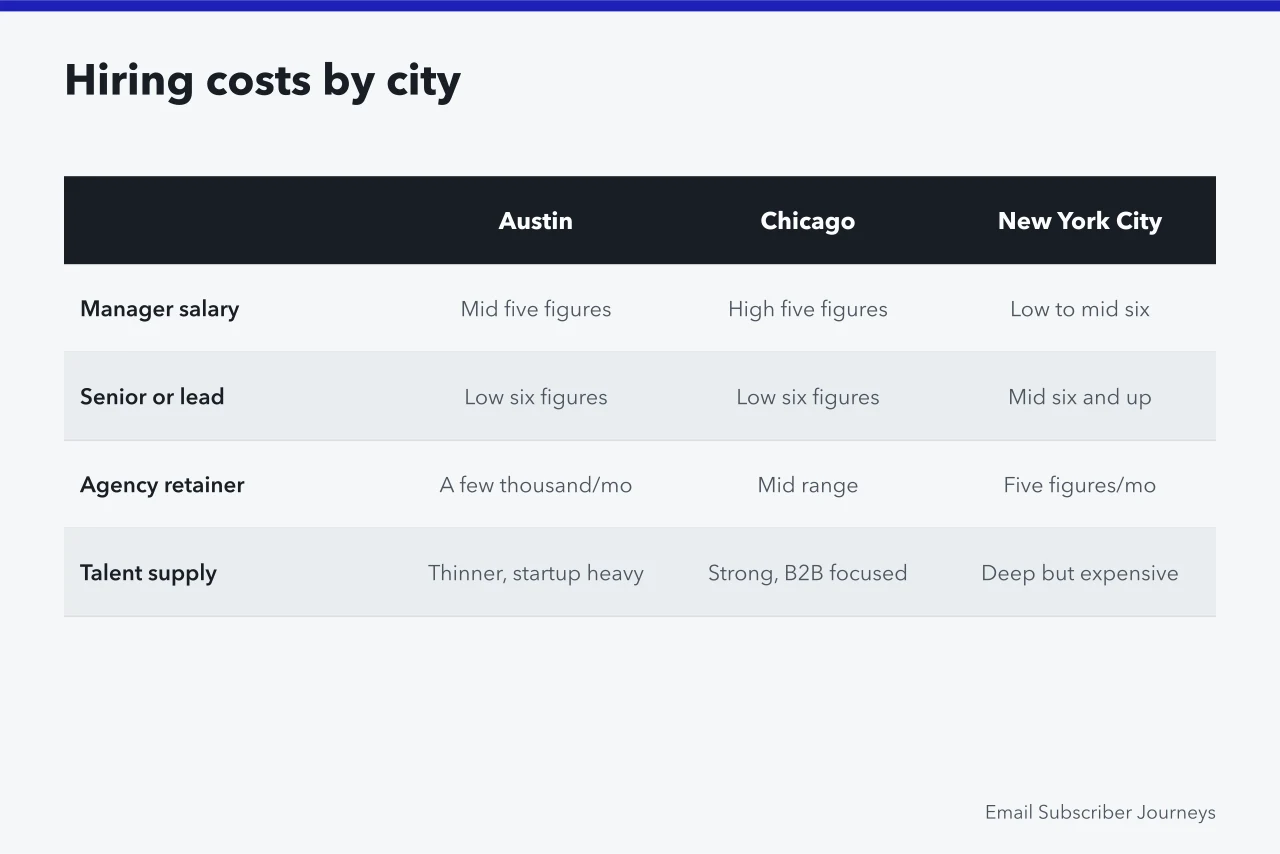
| City | Lifecycle manager salary | Senior or lead salary | Agency retainer range | Talent supply |
|---|---|---|---|---|
| Austin | $80,000 to $100,000 | $105,000 to $130,000 | $2,500 to $7,000 a month | Thinner, startup heavy |
| Chicago | $95,000 to $115,000 | $120,000 to $140,000 | $4,000 to $10,000 a month | Strong, B2B focused |
| New York City | $110,000 to $140,000 | $150,000 and up | $10,000 to $25,000 a month | Deep but expensive |
Across Austin; Chicago; New York City, the same lifecycle manager title carries three different price tags, so benchmark each market on its own. The Bureau of Labor Statistics publishes business cost data that can help you benchmark compensation and vendor spend; see its business costs statistics for the underlying categories.
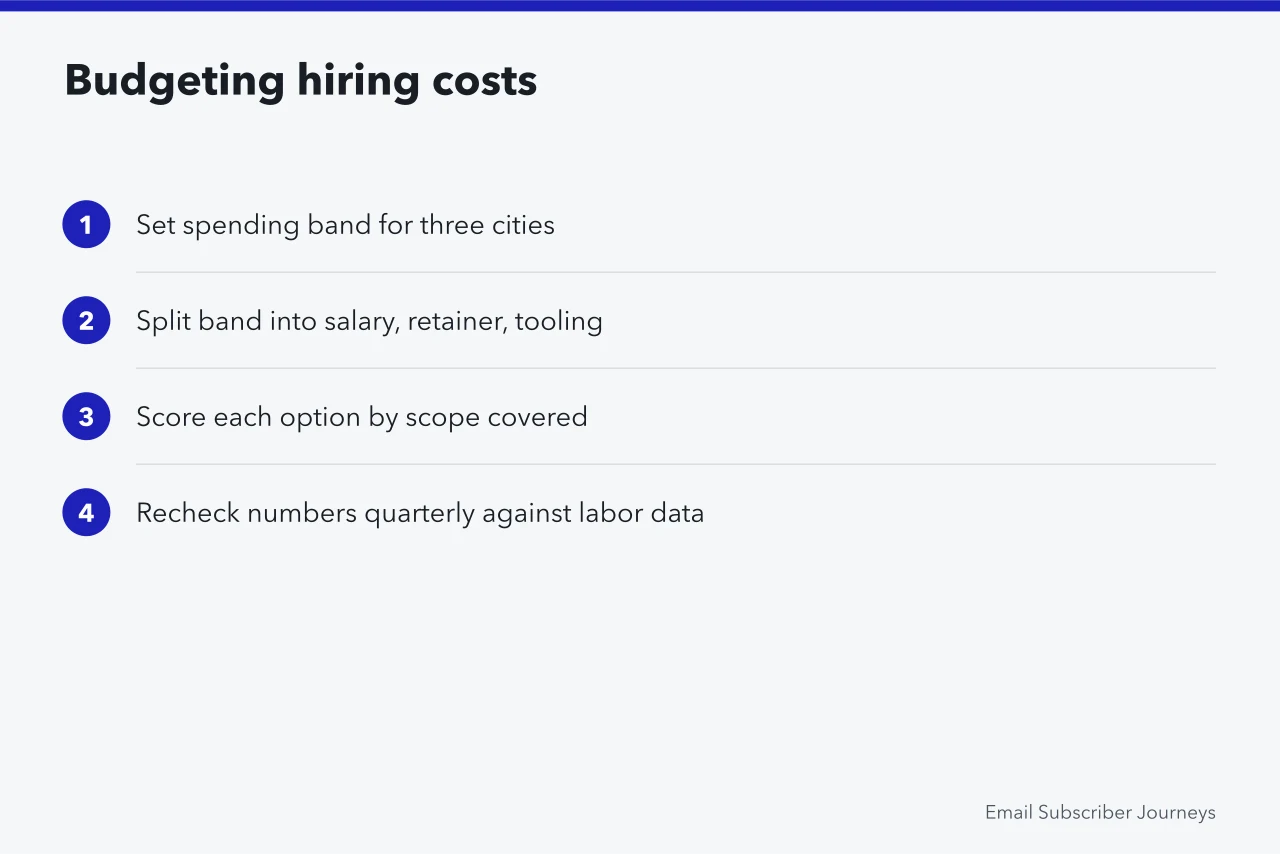
To turn the table into a budget, follow these steps:
- Set a spending band for Austin, Chicago and New York City before you open a role.
- Split the band into salary, agency retainer and tooling costs.
- Score each option by the scope it covers.
- Recheck the numbers each quarter against current labor data.
Hiring costs also include tooling and onboarding. A new lifecycle hire needs access to your email platform, analytics and data warehouse. If your stack is fragmented, expect a longer ramp and higher effective cost. That is one reason teams sometimes start with an agency retainer before they commit to a full time role.
When you compare offers, separate salary from total cost. Add payroll taxes, benefits, tool seats and any agency support you keep in place. A lower salary in Austin can still cost more than a higher salary in Chicago if you need to hire two people to cover the same scope.
What remote and hybrid roles change for email journeys
Remote and hybrid roles have widened the talent pool for email journeys work, but they have not erased local pay differences. Many US companies now post remote lifecycle roles with salary bands tied to the candidate's location. That means a hire in Austin may earn less than a peer in New York City for the same job.
Postings that cover Austin; Chicago; New York City should still carry location based bands, or the pay gap widens quietly. At the startup end of the market, remote roles now outnumber hybrid ones. For employers, that lowers costs and speeds up hiring. For candidates, competition for senior work rises.
Hybrid roles are common in New York City and Chicago, where agencies and brands still value in person collaboration for strategy and client work. Austin has more fully remote roles, partly because its startup scene is used to distributed teams.
If you run a distributed team, document your email journeys and handoffs. Remote work makes it harder to catch deliverability issues early, so set clear ownership for DMARC, list hygiene and suppression management.
The BLS tracks regional employment and wage patterns that can inform how you set remote pay bands; its geography statistics are a reasonable starting point.
You can also time hiring around labor data releases. The BLS publishes a schedule of selected releases that includes employment and cost updates, which helps you plan budget cycles. If you are choosing tools for a distributed team, read how to scope email marketing strategy development without locking yourself into a bad contract.